Key Takeaways
- Buttock pain usually falls into one of three categories: joint-related (hip osteoarthritis), soft tissue-related (gluteal tendinopathy or bursitis), or nerve-related (sciatica, piriformis syndrome, or deep gluteal syndrome).
- Where the pain travels, what makes it worse, and what time of day it is at its worst all give strong clues about the underlying cause.
- Hip osteoarthritis tends to be worse in the morning, eases with gentle movement, and limits specific hip movements like crossing your legs.
- Soft tissue conditions like gluteal tendinopathy and bursitis are usually worse with sitting, lying on the affected side, and prolonged activity.
- Nerve-related buttock pain often travels past the knee with a shooting or electric quality, and is commonly worse with forward bending or prolonged sitting.
- Physiotherapy is the recommended first-line treatment for the vast majority of conditions causing buttock pain, with good evidence supporting positive outcomes.
Quick note: everyone is different. This article is here to help you understand the topic, not replace professional advice. Please speak with your physio about your specific situation.
Table of Contents
- What does your buttock pain feel like?
- What causes buttock pain?
- How a physio tells the difference
- Can physiotherapy help buttock pain?
- What does treatment involve?
- FAQs
I had a moment in clinic last week that summed this whole topic up perfectly.
A client came in convinced she had sciatica. Turned out it was gluteal tendinopathy. Completely different problem, completely different treatment, and she had been doing the wrong exercises for weeks because of it.
It’s no secret that buttock pain confuses a lot of people, and honestly, I get why.
The buttock region is home to a joint, a group of tendons, a bursa, and several major nerves, all sitting close together. So when something in that area starts hurting, without a proper assessment, it is genuinely tricky to know whether you are dealing with arthritis, a soft tissue injury, or a nerve problem.
The encouraging part is that each of these categories has fairly distinct patterns. Once you know what to look for, the picture usually starts to make a lot more sense. Let me walk you through it.
What Does Your Buttock Pain Feel Like?
The character and location of your pain are the biggest clues to what is going on.
- Pain radiating through the hip, groin, and thigh: this pattern, especially when felt deep in the groin as well as the buttock, is commonly reported with hip osteoarthritis.
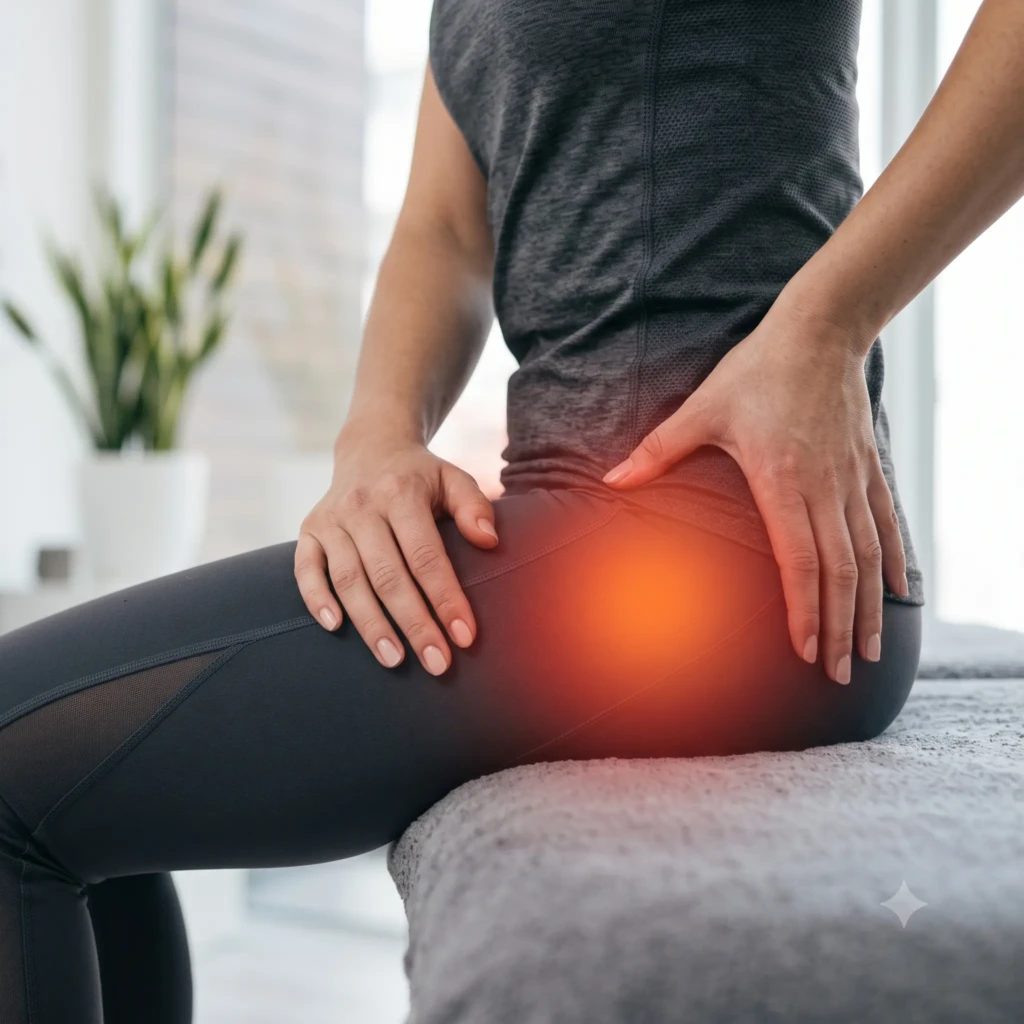
- Localised tenderness over the side of the hip: pain and tenderness directly over the bony point at the top of your thigh bone, known as the greater trochanter, that doesn’t travel past the knee, points toward a soft tissue cause like gluteal tendinopathy or bursitis.
- Shooting, tingling, or electric sensations down the leg: pain that travels past the knee, sometimes described as shooting or electric, especially alongside lower back pain, suggests a nerve- related cause.
Timing of the pain is also relevan:
- Worse first thing in the morning, easing after a few minutes of movement: typical of hip osteoarthritis.
- Worse with sitting or lying on the affected side: typical of soft tissue conditions like bursitis or gluteal tendinopathy.
- Worse getting in or out of a seated position, or with prolonged sitting: more typical of a nerve- related cause.
What Causes Buttock Pain?
Beyond what the pain feels like, there are some other patterns worth paying attention to.
Hip Osteoarthritis
Hip osteoarthritis develops when the cartilage that cushions the hip joint gradually wears down, leading to stiffness, pain, and reduced movement. The Cleveland Clinic notes that osteoarthritis is the most common cause of hip pain and may affect up to 25 percent of people over the age of 55.
A hallmark feature is a reduced range of motion, particularly with movements like crossing your legs, tying your shoelaces, or putting on socks. People often notice their hip simply does not move the way it used to, well before the pain becomes significant.
Gluteal Tendinopathy and Bursitis
Pain on the outer side of the hip and buttock, once commonly labelled trochanteric bursitis, is now understood to most often originate from the gluteal tendons themselves rather than the bursa. The Cleveland Clinic notes that gluteal tendinopathy causes hip pain that frequently extends down the outside of the leg toward the knee, and is often linked to overuse, underuse, or sudden changes in activity level.
A defining feature of this condition is that it tends to improve with gentle activity after a period of rest, but worsens again with prolonged or repetitive activity. We see this a lot in women aged 40 to 60, and research published in the Journal of Orthopaedic and Sports Physical Therapy (Grimaldi and Fearon, 2015) confirms gluteal tendinopathy as the primary source of this type of lateral hip and buttock pain, more so than bursitis alone.
Getting this distinction between the hip tendons and bursas right, impacts, and sometimes changes, how it is treated.
If you have been offered a cortisone injection for this kind of pain, it is worth reading our blog on cortisone injections for tendon pain before deciding what is right for you.
Nerve- Related Buttock Pain
Nerve- related causes of buttock pain include sciatica, piriformis syndrome, and a broader category known as deep gluteal syndrome.
Sciatica refers to irritation of the sciatic nerve as it exits the lower back, typically from a disc issue, causing pain that travels down the leg. If you want to understand sciatica specifically in more depth, we cover this in detail in our blog Can Sciatica Be Cured?
Piriformis syndrome and deep gluteal syndrome describe irritation of the sciatic nerve further along its path, within the buttock itself, often due to tightness or compression from the surrounding muscles rather than the spine.
A common feature across these nerve-related conditions is reduced or painful forward bending. If it hurts to bend forward and try to touch your toes, that is a useful clue pointing toward nerve involvement rather than a purely joint or tendon issue.
How a Physio Tells the Difference
This is where a proper physical assessment really earns its place. A trained physiotherapist uses a combination of history taking and specific hands- on tests to narrow down what is actually going on.
I always tell people: this isn’t guesswork on our end. Every test we do is pointing us toward or away from a specific diagnosis.
Suspected Cause Common Assessment Findings
Hip osteoarthritis | Reduced and painful passive hip range of motion, particularly flexion and rotation, often with a bony or firm end feel. Pain may ease slightly with gentle leg traction.
Gluteal tendinopathy or bursitis | Pain reproduced with single leg standing after 30 seconds, tenderness directly over the greater trochanter, reduced strength and pain with resisted hip movements, particularly combined flexion, adduction, and external rotation.
Nerve- related buttock pain | Positive slump test or straight leg raise reproducing leg symptoms, pain with combined hip flexion, adduction, and internal rotation while lying on your side, and sometimes reduced reflexes at the knee.
These tests are not meant to be done at home as a way of self- diagnosing. They are listed here so you understand what a thorough assessment looks like and why it matters. The same buttock pain can come from very different sources, and getting the diagnosis right changes everything about the treatment approach.
Not sure what is causing your buttock pain? That is exactly what a proper assessment is for. Book online here, and we will help you get a clear picture.
Can Physiotherapy Help Buttock Pain?
Yes, for the vast majority of the conditions that cause buttock pain. How good is that to hear, especially if you have been struggling with this for a while?
Physiotherapy is widely regarded as the gold standard, first- line treatment for hip osteoarthritis, gluteal tendinopathy, bursitis, gluteal muscle strain, sciatica, piriformis syndrome, and the broader nerve syndromes that fall under deep gluteal syndrome. The research consistently shows that outcomes improve significantly with the right physiotherapy- based intervention, regardless of which of these conditions is the underlying cause.
At Physio Club, our physiotherapists start with a thorough assessment to identify exactly what is driving your symptoms, then build a treatment plan tailored to that specific diagnosis. We’re lucky to have a team that genuinely loves working through cases like this.
What Does Treatment for Buttock Pain Involve?
Treatment looks quite different depending on the underlying cause, but a typical, comprehensive approach may include:
- Symptom management strategies to reduce pain in the early stages
- Manual therapy techniques to improve mobility and reduce muscle guarding
- Active range of motion exercises and joint mobilisation with movement
- Soft tissue release for tight or overactive muscles contributing to your symptoms
- Progressive, individually tailored home exercise programs to build strength and function over time
- Neural gliding exercises for nerve- related presentations, helping the nerve move more freely through surrounding tissue
Treatment for Gluteal Tendinopathy
Treatment generally involves gradual, progressive loading of the tendon rather than rest or stretching. In fact, aggressive stretching of the hip into positions of adduction can actually increase compression on the gluteal tendons and aggravate symptoms, so this is an important distinction from how some other soft tissue injuries are managed.
Treatment for Hip Osteoarthritis
Treatment focuses on maintaining and improving the joint range of motion, building strength around the joint, and managing load through daily activities to keep you moving comfortably for as long as possible.
Treatment for Nerve-Related Buttock Pain
Treatment typically targets the source of the nerve irritation, whether that is in the lower back or within the buttock itself, alongside neural mobility work and addressing any contributing muscle tightness or weakness. If your nerve symptoms travel down the leg in a sciatic pattern, our blog on sciatica covers this specific presentation in much more depth, including realistic recovery timelines.
In all cases, getting an accurate diagnosis first is what allows us to choose the right combination of these approaches, rather than applying a generic treatment that may not address the actual problem.
Not just because it gets you better faster. Not just because it saves you weeks of doing the wrong exercises. But because it means you actually understand what is going on with your own body.
Buttock Pain Treatment in Engadine and Sutherland
We see a wide range of buttock pain presentations at Physio Club, from hip osteoarthritis in older clients to gluteal tendinopathy in runners and nerve- related pain in people who spend long hours sitting at a desk. Whatever the cause, getting it properly assessed early means you get the right treatment from the start, rather than guessing.
We’re lucky to work with such a great community across the Sutherland Shire, and helping people get back to moving without pain never gets old for us. ☕
We have clinics in Engadine and Sutherland.
Curious whether this sounds like what you are dealing with? You can book online here to get assessed, or shoot us a message if you have questions before booking. We will point you in the right direction
FAQs
Can hip osteoarthritis and gluteal tendinopathy occur at the same time?
Yes, and this is actually quite common, particularly in people over 50. The two conditions can coexist and sometimes feed into each other, as altered hip mechanics from osteoarthritis can place extra load on the gluteal tendons. A thorough assessment is important in these cases because treatment needs to address both issues rather than focusing on just one.
Is buttock pain ever a sign of something more serious?
In rare cases, yes. Buttock pain accompanied by unexplained weight loss, fever, significant unrelenting night pain, loss of bladder or bowel control, or numbness in the groin and inner thighs (saddle area) needs urgent medical assessment. These are not typical features of arthritis, tendinopathy, or common nerve entrapments, and should be checked promptly.
Why does my buttock pain get worse when I sit?
This is one of the most common patterns we see, and it can point to a few different causes. Gluteal tendinopathy and bursitis are aggravated by sitting because it compresses the tendons against the greater trochanter. Nerve- related causes, including piriformis syndrome and deep gluteal syndrome, are also commonly aggravated by sitting because of direct compression on the sciatic nerve in that region. A physio assessment will help determine which of these is driving your specific symptoms.
Will I need imaging (a X-ray or MRI) for buttock pain?
Not always. Most causes of buttock pain can be diagnosed clinically through a thorough history and physical examination. Imaging is sometimes used to confirm hip osteoarthritis or to investigate nerve- related symptoms that are not responding to initial treatment, but it is not always the first step. Your physio will let you know if imaging would add useful information for your specific situation.
Can gluteal tendinopathy go away without treatment?
Unlike some other soft tissue injuries, gluteal tendinopathy tends not to resolve well with rest alone, and prolonged rest can sometimes make things worse by allowing the tendon and surrounding muscles to weaken further. The most effective approach is progressive, guided loading through physiotherapy, which addresses the underlying capacity of the tendon rather than just avoiding aggravating positions.
How is piriformis syndrome different from sciatica caused by the lower back?
Both produce similar symptoms, pain travelling down the leg in a sciatic distribution, but the source of the nerve irritation is different. Sciatica from the lower back originates at the nerve root as it exits the spine, usually from a disc issue. Piriformis syndrome and deep gluteal syndrome involve irritation of the sciatic nerve further along its path, within the buttock itself. A physio assessment, including specific tests for the lower back and the deep gluteal region, helps determine which is the actual source.
References and Further Reading
The following sources were referenced in this article.
- Cleveland Clinic: Hip Arthritis: Causes, Symptoms and Treatment Options
- Cleveland Clinic: Gluteal Tendinopathy: Symptoms, Causes and Treatment
- Grimaldi A, Fearon A. Gluteal Tendinopathy: Integrating Pathomechanics and Clinical Features in Its Management. Journal of Orthopaedic and Sports Physical Therapy, 2015.
- Wikipedia: Deep Gluteal Syndrome
Related reading from Physio Club:
- Can Sciatica Be Cured?
- Cortisone Injections for Tendon Pain: Are They Worth It?
- Best Stretches for Tight Hip Flexors
- Sprained Ankle: Rehab, Recovery and Getting Back to Sport
- Physiotherapy at Physio Club
This article is intended as general information only and does not replace professional medical advice. If you are experiencing buttock or hip pain, please speak with a qualified physiotherapist or healthcare provider.
Tom Hol | Director at Physio Club | Meet the Physio Club team