Key Takeaways
- Ankle sprains are one of the most common injuries we see in clinic, but they are also one of the most under-rehabilitated.
- The grade of your sprain determines how the ligaments are affected and gives us a realistic sense of recovery time.
- Most people can weight-bear and start gentle movement early. Complete rest is rarely the right approach.
- The PEACE and LOVE framework has replaced RICE as the evidence-based approach for managing acute ankle sprains.
- Poor rehabilitation significantly increases your risk of re-injury. Research shows that a history of ankle sprains is the single biggest risk factor for future ankle sprains.
- There are simple functional tests we use in clinic to determine when you are actually ready to return to sport, not just when the pain has settled.
This article is here to help you understand ankle sprains and rehabilitation. It is not a substitute for professional assessment. Please see your physio or doctor if you are unsure about the severity of your injury.
Table of Contents
- What is a sprained ankle?
- Grading your ankle sprain
- Immediate management: why RICE is no longer the gold standard
- How long does a sprained ankle take to heal?
- Ankle sprain rehab: what does it actually involve?
- When are you actually ready to return to sport?
- Why proper rehab matters more than most people realise
- Does taping help a sprained ankle?
- Should I see a physio for a sprained ankle?
- FAQs
A lot of people come in after rolling their ankle wondering the same thing: do I really need to get this properly assessed, or can I just rest it and see how it goes?
It is a fair question. Ankle sprains are so common that they can feel like just one of those things. You roll it, it swells up, you limp around for a few days, and eventually it feels okay. So you go back to sport. And then you roll it again.
That cycle is more common than it should be. And it is almost always the result of under-rehabilitation.
The research is very clear on this: a history of ankle sprains is the single biggest risk factor for future ankle sprains. The good news is that proper rehabilitation breaks that cycle. Here is what you need to know.
What Is a Sprained Ankle?
An ankle sprain occurs when one or more of the ligaments supporting the ankle joint are stretched beyond their normal range, resulting in partial or complete tearing of the ligament fibres.
The most common type is a lateral ankle sprain, where the foot rolls inward (inversion) and the ligaments on the outer side of the ankle are overstretched. These ligaments, primarily the anterior talofibular ligament (ATFL) and the calcaneofibular ligament (CFL), are the ones most frequently damaged in sporting injuries, trips, and falls.
Less commonly, an eversion sprain occurs when the foot rolls outward, affecting the ligaments on the inner side of the ankle. These tend to be less common but often more significant when they do happen.
Ankle sprains affect people of all ages and activity levels. They account for a significant proportion of sporting injuries and emergency department presentations, yet they are frequently under-managed once the acute pain settles.
Grading Your Ankle Sprain
Not all ankle sprains are the same. The traditional grading system gives us a useful starting point for understanding the severity of the injury and what to expect for recovery.
| Grade | Tissue Damage | Symptoms | Weight Bearing |
|---|---|---|---|
| Grade I | Microscopic tearing, no macroscopic damage | Mild swelling and tenderness, minimal impact on function | Usually possible with discomfort |
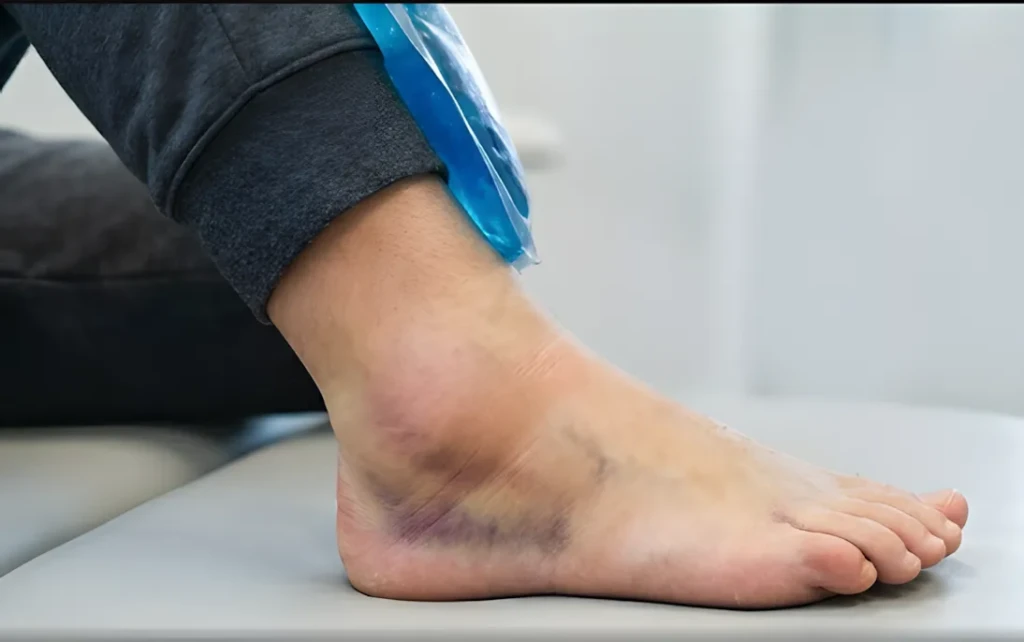
| Grade II | Partial ligament tear | Moderate swelling, pain, bruising, some instability | Painful but typically possible |
| Grade III | Complete ligament rupture | Significant swelling, bruising, marked instability, loss of function | Difficult or not possible initially |
In practice, grading by symptom severity is often more useful than grading purely by structural damage, because the degree of swelling, pain, functional loss, and instability is what shapes the early management approach.
It is also worth noting that severe swelling, significant tenderness over the bone itself, or an inability to weight bear for more than a few steps can be signs of a fracture rather than a pure ligament injury. The Ottawa Ankle Rules are a simple clinical tool used to determine when imaging is needed. If you are not sure, get assessed.
Immediate Management: Why RICE Is No Longer the Gold Standard
Most people are familiar with RICE: rest, ice, compression, elevation. It has been the standard advice for ankle sprains for decades. But the evidence has moved on significantly, and the current best practice approach is quite different.
The PEACE and LOVE framework, published in the British Journal of Sports Medicine in 2020 (Dubois and Esculier), replaced RICE as the recommended approach for managing acute soft tissue injuries, including ankle sprains. It reflects what we now know about how tissues heal and how early movement supports better outcomes.
PEACE: The First 1 to 3 Days
- Protect: reduce activity and avoid movements that provoke pain for the first one to three days. This does not mean complete rest. Minimise prolonged immobilisation.
- Elevate: keep the ankle elevated above heart level where possible to help fluid move away from the injured area.
- Avoid anti-inflammatories: inflammation is part of the natural healing process. Evidence now suggests that anti-inflammatory medication in the first few days may interfere with tissue repair. Check with your doctor if you are managing significant pain.
- Compress: a compression bandage or tubigrip can help manage swelling and provide some support.
- Educate: understanding your injury and having realistic expectations about recovery reduces anxiety and leads to better outcomes.
LOVE: From Day 4 Onward
- Load: early, gradual loading of the ankle is beneficial. Gentle weight bearing, within pain limits, promotes healing and prevents the weakness that comes with immobilisation.
- Optimism: psychological factors including fear of re-injury and negative expectations are genuine barriers to recovery. Realistic optimism about your outcome matters.
- Vascularisation: gentle cardiovascular activity that does not aggravate the ankle (swimming, cycling) boosts blood flow to the healing tissue and maintains fitness during recovery.
- Exercise: progressive rehabilitation through strength, mobility, and balance training is the most important part of a full recovery. More on this below.
The key shift from RICE to PEACE and LOVE is the emphasis on early movement and loading rather than rest and ice. This does not mean pushing through significant pain. It means avoiding the trap of doing nothing and expecting the ankle to rehabilitate itself.
How Long Does a Sprained Ankle Take to Heal?
This is the most common question we get after the initial assessment. And the honest answer is: it depends on the grade of the sprain, how quickly rehabilitation is started, and how consistently it is done.
As a general guide:
- Grade I sprains: one to three weeks for most daily activities, with sport-specific rehabilitation extending a little longer.
- Grade II sprains: four to eight weeks for full rehabilitation, though return to low-impact activity is often possible sooner.
- Grade III sprains: eight to twelve weeks or more, with some people taking longer depending on the level of instability and the demands of their sport.
These are timelines for rehabilitation, not just pain resolution. This is an important distinction. The pain from an ankle sprain often settles well before the joint has regained the strength, proprioception, and stability it needs to handle sport safely.
Returning to sport once the pain has gone, without completing rehabilitation, is the most common reason people end up back in the clinic with another sprain six weeks later.
Ankle Sprain Rehab: What Does It Actually Involve?
Good ankle sprain rehabilitation is progressive. It builds from early pain management through to sport-specific movement, and it does not skip steps.
Here is how we typically structure it:
Phase 1: Early Management (Days 1 to 7)
- Gentle range of motion exercises: ankle circles, alphabet tracing, and gentle dorsiflexion and plantarflexion to maintain mobility
- Weight bearing as tolerated: walking with a normal gait pattern rather than limping helps the joint load progressively
- Compression and elevation to manage swelling
- Taping if appropriate, to provide support and reduce pain during movement
Phase 2: Building Strength and Proprioception (Weeks 2 to 4)
- Calf raises: starting with double leg on flat ground, progressing to single leg and eventually off a step
- Resistance band exercises: strengthening the muscles around the ankle in all directions, particularly eversion and dorsiflexion
- Single leg balance: standing on the injured leg with eyes open, progressing to eyes closed and unstable surfaces
- Step exercises: stepping up and down to build strength and coordination
Proprioception, which is your body’s ability to sense joint position and coordinate movement, is one of the most critical things to rehabilitate after an ankle sprain. Loss of proprioception is a major contributor to recurrence and chronic instability.
Phase 3: Return to Activity (Weeks 4 Onward)
- Progressive hopping and jumping: starting with double leg, moving to single leg, then in multiple directions
- Change of direction and agility work: simulating the demands of your sport
- Sport-specific drills: running, kicking, cutting movements relevant to your activity
- Return to full training and match play when functional criteria are met
A systematic review published in PLOS ONE (Wagemans et al., 2022) found that exercise-based rehabilitation significantly reduced re-injury rates in people who had sustained an acute ankle sprain. People who completed a structured rehabilitation program had meaningfully lower recurrence rates than those who received usual care alone.
For netballers in particular, the Netball Australia KNEE program is a structured warm-up and injury prevention program that directly addresses ankle and lower limb injury risk. It is worth reading if you play netball or coach a netball team.
When Are You Actually Ready to Return to Sport?
Being pain is not the same as being ready to play. This is one of the most important things I try to communicate in clinic, because the gap between the two is exactly where most re-injuries happen.
We use a set of functional criteria to determine readiness for return to sport. These tests compare your injured side to your uninjured side and give us an objective measure of whether the ankle has genuinely recovered.
- Knee to wall test: this measures ankle dorsiflexion range of motion. Standing facing a wall, you slide your foot back until your knee just touches the wall with your heel flat on the ground. The distance from your big toe to the wall should be equal on both sides. A difference of more than one centimetre is significant.
- Single leg hop for distance: hop as far as you can on the injured leg and compare the distance to your uninjured leg. Both sides should be within five centimetres of each other.
- Single-leg calf raises off a step: aim for 25 repetitions on the injured side, matching the uninjured side.
- Hop on and off a step: 10 repetitions each side, landing with control and without compensating.
- Single leg balance: 30 seconds on each leg, eyes closed, without excessive wobbling or putting the other foot down.
These are not arbitrary tests. They reflect the demands that sport actually places on the ankle. If you cannot hop off one leg symmetrically, you are not ready to play sport that involves running, jumping, or changing direction.
Your physio will guide you on when these tests are appropriate to attempt and how to interpret the results in the context of your specific sport and activity level.
Not sure if you are ready to go back? Come in and do a proper return to sport assessment with us. It takes the guesswork out of it completely. Book online here.
Why Proper Rehab Matters More Than Most People Realise
There is a widespread perception that ankle sprains are minor injuries that sort themselves out with a bit of rest. And while mild sprains do often settle down on their own, the ankle rarely returns to full function without active rehabilitation.
Research shows that less than 50 percent of people who sprain their ankle seek professional management, yet a history of previous ankle sprains is consistently identified as the strongest risk factor for recurrence.
What often gets left behind after an ankle sprain:
- Proprioception: the sensory feedback system that helps your ankle react automatically to uneven ground. This is damaged in every sprain and requires specific training to restore.
- Peroneal muscle strength: the muscles on the outside of the lower leg that actively protect the ankle against rolling. These weaken quickly after injury.
- Movement confidence: fear of re-injury changes the way people move, often in ways that increase rather than decrease their actual risk.
Addressing all three of these is what good rehabilitation does. And it is what separates people who recover fully from those who end up dealing with a chronically unstable or repeatedly injured ankle.
This same principle applies across most soft tissue injuries. Our blogs on corked muscle recovery and Osgood Schlatter disease both reinforce the same message: early, structured rehabilitation delivers better outcomes than rest and hope.
Does Taping Help a Sprained Ankle?
Yes, in the right context.
Taping can be really useful in the early stages of an ankle sprain to manage pain and provide proprioceptive support while the ligaments are healing. It does not substitute for rehabilitation, but it can make the early phases more comfortable and allow you to move with more confidence.
At Physio Club, our physios are experienced in ankle taping techniques, including both rigid sports tape and kinesiology tape, and will advise on whether taping is appropriate for your situation and stage of recovery.
As rehabilitation progresses, the goal is always to reduce reliance on external support and build the ankle’s own intrinsic stability through strength and proprioception training.
Should I See a Physio for a Sprained Ankle?
Yes. And the sooner the better.
A physiotherapy assessment after an ankle sprain is not just about confirming the diagnosis. It gives you a clear picture of the severity of the injury, rules out associated injuries like fractures or tendon damage, establishes an accurate recovery timeline, and sets you up with a structured rehabilitation program from day one.
The people who tend to recover fastest are not necessarily those with the mildest sprains. They are the ones who start rehabilitation early and follow it through properly.
You do not need a GP referral to see a physio in Australia. You can book directly with us at Physio Club Sutherland or Physio Club Engadine.
Some signs that you should definitely get accessed sooner rather than later:
- Significant swelling and bruising that develops quickly
- Inability to weight-bear for more than a few steps
- Tenderness directly over the bone rather than the soft tissue
- A popping or snapping sensation at the time of injury
- Previous ankle sprains that never fully settled
- A sense that the ankle is unstable or giving way
Ankle Sprain Treatment in Engadine and Sutherland
We see a lot of ankle sprains at Physio Club, across all ages and activity levels. Whether it happened on the footy field, in a netball game, stepping off a kerb, or during a trail run, the approach is the same: get it properly assessed, understand what you are dealing with, and build a rehabilitation program that gets you back to full function without cutting corners.
We are lucky to work with athletes and active people from right across the Sutherland Shire. And how good is it when someone comes back in months after a nasty ankle sprain and tells us they have not had a single re-injury? That is exactly what good rehab should deliver.
We have clinics in Engadine and Sutherland, and you can learn more about how we approach sports injuries on our sports physiotherapy page or physiotherapy services page.
Ready to get your ankle sorted? Book online here. If you have questions before booking, get in touch and we are happy to point you in the right direction.
FAQs
Should I go to hospital or see a physio for a sprained ankle?
If you cannot bear any weight at all, have significant tenderness directly over the bone, or sustained a severe high-energy injury, it is worth going to an emergency department or GP first to rule out a fracture. The Ottawa Ankle Rules provide a simple clinical guide for when imaging is needed. For most ankle sprains, a physiotherapy assessment is the most appropriate first step. Your physio can refer you for imaging if needed and will not require a GP referral.
How do I know if I have torn a ligament or just sprained my ankle?
The distinction is really about severity. A Grade I sprain involves microscopic tearing of the ligament with the overall structure intact. A Grade III sprain involves complete rupture of the ligament. Most ankle sprains fall somewhere in between. A clinical assessment by a physio is the most reliable way to determine the grade, and ultrasound or MRI can confirm this if needed. The good news is that even complete ligament ruptures in the ankle are generally managed conservatively (without surgery) in most cases.
Can I run with a sprained ankle?
It depends on the grade and where you are in your recovery. In the acute phase, running will almost certainly aggravate the injury and slow healing. As rehabilitation progresses, a graded return to running is an important part of the program. Your physio will guide you on when running is appropriate and how to build back up gradually using the same functional criteria we use for return to sport.
Is it okay to play sport with a mild ankle sprain?
A Grade I sprain with minimal swelling and near-full function may allow a return to sport relatively quickly with appropriate taping or bracing. However, returning to collision or court sport without completing basic rehabilitation significantly increases your re-injury risk. Even for mild sprains, a few days of proper management and at least one or two sessions of targeted rehabilitation makes a meaningful difference to long-term outcomes.
Can ankle sprains cause long-term problems?
Yes, if they are not rehabilitated properly. Chronic ankle instability, where the ankle repeatedly gives way or feels unreliable, is a direct consequence of inadequate rehabilitation after acute sprains. Proprioception deficits, peroneal muscle weakness, and altered movement patterns all persist if they are not specifically addressed. The research on this is clear: people who complete structured rehabilitation after an ankle sprain have significantly lower rates of chronic instability and recurrence.
Is it normal for my ankle to still be swollen weeks after a sprain?
Some residual swelling can persist for weeks to months after a significant ankle sprain, particularly at the end of the day or after activity. This is normal and not necessarily a sign that something is wrong. However, if swelling is increasing rather than gradually reducing, or if you have significant pain and instability alongside it, come in and get it reassessed. There may be an associated injury that was has been missed.
References and Further Reading
The following sources were referenced in this article.
- Dubois B, Esculier JF. Soft-tissue injuries simply need PEACE and LOVE. British Journal of Sports Medicine, 2020.
- Wagemans J et al. Exercise-based rehabilitation reduces reinjury following acute lateral ankle sprain: A systematic review update with meta-analysis. PLOS ONE, 2022.
Related reading from Physio Club:
- Calf Strain vs Tear: Soleus or Gastrocnemius?
- Netball Injuries: How to Reduce ACL Injury Risk with the Netball Australia KNEE Program
- Corked Muscle: What It Is, How to Grade It, and the Best Way to Treat It
- Osgood Schlatter Disease: Symptoms, Treatment and Taping
- Sports Physiotherapy at Physio Club
This article is intended as general information only and does not replace professional medical advice. If you have sustained an ankle injury, please seek assessment from a qualified physiotherapist or medical professional.
Tom Hol | Director at Physio Club | Meet the Physio Club team