Key Takeaways
- Osgood-Schlatter disease is one of the most common causes of knee pain in active adolescents, affecting roughly 1 in 10 young athletes aged 8 to 15.
- It is caused by repetitive stress on the tibial tuberosity (the bony bump just below the kneecap) during growth spurts, most often through running, jumping, and sprinting sports.
- Symptoms include pain, tenderness, and sometimes a visible lump just below the kneecap, which can affect one or both knees.
- The condition is self-limiting and almost always resolves once the growth plate closes at the end of puberty. However, the right management during that time makes a real difference to how much it disrupts sport and daily life.
- Physiotherapy, load management, taping, and targeted stretching and strengthening are the cornerstones of treatment. Surgery is rarely needed.
- Osgood-Schlatter in adults does occur, usually in people whose symptoms were not well managed in adolescence. It is treatable.
Quick note: every person’s situation is different. Please talk to your physio or doctor about your specific circumstances. This article is here to help you ask the right questions, not replace professional advice.
A lot of parents come into the clinic a bit worried because their kid has been complaining about knee pain after sports: there’s a tender lump below the kneecap, and they’re not sure whether to push through, rest up, or do something about it.
It’s no secret that growing kids who play a lot of sport put some serious load through their bodies. Osgood-Schlatter disease is one of the most common ways that shows up.
The good news is this: it is manageable. And we see kids get back to full sport all the time with the right approach.
At Physio Club, we work with young athletes from across the Sutherland Shire whose parents want to keep them active, not just tell them to stop. So today, I want to walk you through what Osgood-Schlatter disease actually is, how we diagnose it, what treatment looks like, and the taping techniques we use to help keep kids comfortable while they recover.
What Is Osgood-Schlatter Disease?
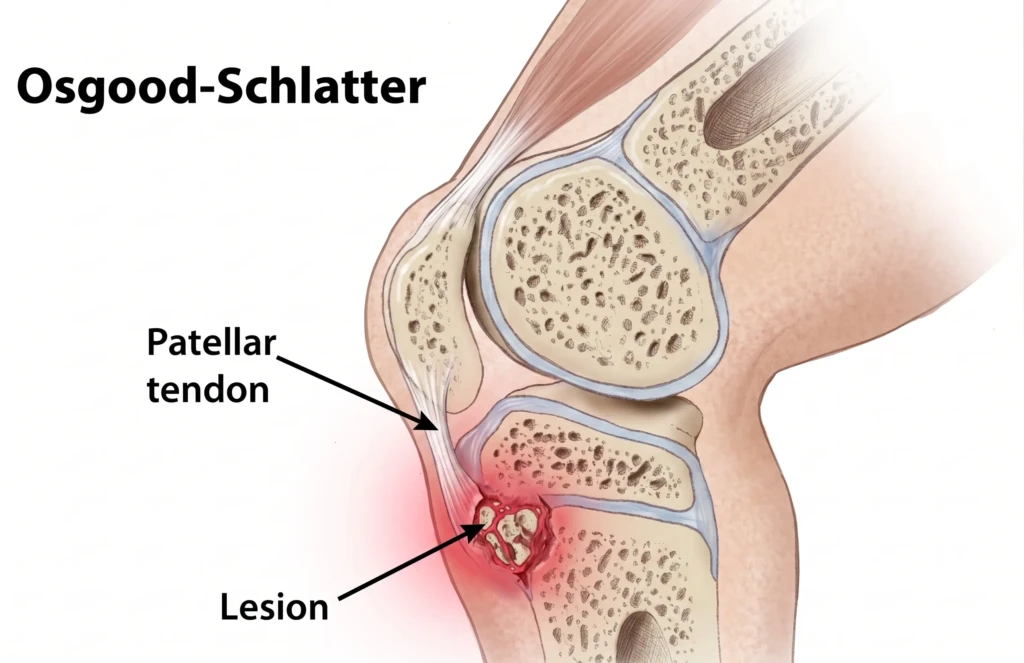
Osgood-Schlatter disease is a condition that causes pain and tenderness at the tibial tuberosity, which is the bony bump you can feel just below the kneecap at the top of the shin. It is classified as a traction apophysitis, which in plain English means it is an overuse injury to the growth plate where the patellar tendon attaches to the bone.
Here is what is happening underneath the skin:
During a growth spurt, bones grow faster than muscles and tendons can keep up. This creates increased tension in the patellar tendon. Every time a young athlete runs, jumps, or kicks, that tendon pulls hard on the still-developing growth plate at the tibial tuberosity. Over time, with enough repetition, this causes irritation, inflammation, and sometimes small changes to the bone itself.
According to the National Institutes of Health, Osgood-Schlatter disease is one of the most common causes of knee pain in the skeletally immature adolescent athlete, with a prevalence of around 9.8 per cent in young people aged 12 to 15. It is more common in males and occurs most frequently in athletes who play sports involving running and jumping.
The condition was first described in 1903 by two surgeons independently, Robert Osgood in the US and Carl Schlatter in Switzerland, and it remains one of the most frequently seen conditions in junior sport to this day.
Who Gets Osgood-Schlatter Disease?
Never a dull moment in a growing athlete’s household! Osgood-Schlatter disease tends to appear during that rapid growth window in early adolescence. The typical age range is:
- Girls: 8 to 13 years
- Boys: 10 to 15 years
Boys are more commonly affected, though the gap has narrowed as female participation in sport has grown. The condition affects both knees in 20 to 30 per cent of cases.
The sports most commonly associated with Osgood-Schlatter disease are those with high volumes of running, jumping, and direction change:
- Football, soccer, and rugby
- Basketball and netball
- Athletics, including sprinting and long jump
- Gymnastics and dance
- Any sport involving repeated acceleration and kicking
That said, less active kids can get it too if they go through a rapid growth spurt. The common thread is the growth plate, not necessarily the sport.
Osgood-Schlatter Disease Symptoms
How do you know if it is Osgood-Schlatter and not just general growing pains? Here is what to look for.
The classic presentation is:
- Pain, tenderness, and swelling directly over the tibial tuberosity, the bony bump just below the kneecap
- Pain that comes on during or after exercise, particularly running, jumping, kicking, or going up and down stairs
- Pain that eases with rest
- A visible or palpable lump that develops below the kneecap over time in more established cases
- Pain with direct pressure on the area, such as kneeling
- Sometimes a limp after activity
One of the things I always explain to families is that the pain is very localised. It is not a general aching knee. You can usually press directly on the tibial tuberosity and reproduce the pain quite specifically. That is a helpful sign for us in assessment.
Symptoms tend to fluctuate. Kids often feel fine on rest days and then sore again after a big training session or game. That pattern of activity-related pain is really characteristic of Osgood-Schlatter disease.
How Is Osgood-Schlatter Disease Diagnosed?
The good news is that Osgood-Schlatter disease is primarily a clinical diagnosis, meaning a thorough history and physical assessment are usually all that is needed. You do not need a GP referral to come and see us.
When we see a young athlete at Physio Club, we will take a detailed history including the age of onset, what sports they play, how much training volume they do, and exactly where and when the pain occurs. We will then perform a physical assessment, which typically includes:
- Palpation of the tibial tuberosity to reproduce and localise the pain
- Observation of any visible swelling or bony prominence below the kneecap
- Range of motion testing at the knee and hip
- Strength testing of the quadriceps and hamstrings
- Assessment of lower limb biomechanics, including foot posture and movement patterns
In most cases, that is enough to confirm the diagnosis confidently. Occasionally, we will refer for imaging if the presentation is unclear or we want to rule out other conditions. X-rays can show changes to the tibial tuberosity in established cases. MRI is used in more complex situations. Your physio can organise those referrals for you if needed.
No referral needed. You can book directly with us at Physio Club Sutherland or Physio Club Engadine. We will assess your child, give you a clear diagnosis, and put together a plan that keeps them as active as possible.
Osgood-Schlatter Disease Treatment
Here is the thing I want every parent to understand: Osgood-Schlatter disease is a self-limiting condition (resolves without intervention). According to research published in the NIH StatPearls database, it almost always resolves once the growth plate closes at the end of puberty. That is genuinely reassuring.
But that does not mean you just wait it out and hope for the best. Good management during this period makes a real difference to how much pain your child is in, how much sport they can keep playing, and whether any complications develop.
Treatment for Osgood-Schlatter disease is almost always conservative, meaning no surgery. The goals are to manage pain, reduce load on the tibial tuberosity, and keep your child as active as safely possible.
Pain Management and Acute Flare-Ups
When symptoms are at their worst, the first priority is settling the pain down:
- Ice applied to the tibial tuberosity for 15 to 20 minutes after activity (wrapped in a cloth, not applied directly to skin)
- Rest from the specific aggravating activities for a short period, typically 24 to 72 hours after a flare-up
- Temporary activity modification rather than full rest, which helps avoid deconditioning
- Anti-inflammatory medications, if appropriate, on advice from your GP
Load Management
This is probably the most important part of treatment and the area where a good physio makes the biggest difference.
We are not trying to stop your child from playing sports entirely. We want to keep them active while giving the growth plate enough recovery time. That usually means:
- Adjusting training volume and intensity, particularly reducing jumping and sprinting loads
- Modifying sport participation rather than withdrawing entirely when possible
- Graduated return to full training once symptoms settle
- Working with coaches and parents to manage training spikes, particularly after school holidays or pre-season ramp-ups
Stretching and Strengthening
This is a really important part of treatment that is often underestimated. The reason Osgood-Schlatter develops in the first place is that the muscle and tendon unit cannot keep pace with how fast the bone is growing. So we address that directly.
Our physiotherapy team at Physio Club will design a program that typically includes:
- Quadriceps and hip flexor stretching to reduce tension through the patellar tendon
- Hamstring stretching to improve overall lower limb flexibility
- Progressive quadriceps strengthening to build the muscles around the knee and reduce load on the growth plate
- Hip and gluteal strengthening to improve overall lower limb biomechanics
- Calf and ankle mobility work where relevant
Research published in PMC confirms that a combination of load management and targeted exercise is the foundation of conservative treatment, and that most young athletes return to full sport with this approach.
Footwear and Orthotics
Sometimes we also look at what is happening below the knee. Poor foot biomechanics can change how load travels up through the leg and increase stress at the tibial tuberosity.
We may recommend:
- Supportive footwear appropriate for the sport
- Replacing worn-out athletic shoes or boots, particularly for field sports
- Custom-fitted orthotics, in some cases, to help distribute pressure more evenly through the foot and lower leg
Osgood-Schlatter Taping
Taping is something we use regularly with Osgood-Schlatter disease, and a lot of families find it really helpful for keeping kids comfortable during sports.
The two main approaches we use are patellar tendon taping and general knee support taping. Both work by offloading some of the force through the patellar tendon and tibial tuberosity during activity.
Patellar Tendon Taping
This is the most targeted technique for Osgood-Schlatter disease. Sports tape is applied directly across the patellar tendon to reduce the pulling force at the tibial tuberosity during activity. It is straightforward to apply, and many kids and parents can learn to do it at home once a physio has shown them the correct technique.
If tendon taping provides relief, neoprene patella tendon knee straps can be purchased. They are more easily applied and removed, and prevent skin irritation from recurrent taping.
General Knee Support Taping
For more generalised knee discomfort, a broader knee taping technique can help support the joint and reduce pain during activity. This is particularly useful on days when kids have a big training load or a game and need a bit of extra support around the knee.
A few things worth knowing about taping:
- Tape is a short-term management tool, not a long-term fix. It works best alongside the stretching, strengthening, and load management program.
- Some kids find a simple neoprene knee sleeve just as effective for daily comfort during sport.
- If the tape irritates the skin, we can show you an alternative application technique or suggest a different product.
Osgood-Schlatter Disease in Adults
I want to address this because it comes up more often than you might think.
For most people, Osgood-Schlatter disease fully resolves when the growth plate closes in late adolescence. But for some adults, especially those whose condition was not well managed when they were younger, symptoms can persist or recur.
In adults, the typical presentation is persistent pain and tenderness at the tibial tuberosity, sometimes with a prominent bony lump that remains from adolescence. Activities like kneeling, squatting, or high impact sport can aggravate it.
According to research published in PMC, in rare cases where the growth plate fragments did not fully fuse during adolescence, a small bony ossicle (fragment) can remain and become a source of ongoing pain. In those cases, conservative treatment is still the first step, but surgical removal is occasionally considered if symptoms do not resolve.
If you are an adult with ongoing knee pain at the tibial tuberosity, come in and let us take a look. It is very treatable in most cases, and you do not have to just put up with it.
Our Goal: Keep Your Kids Active
How good is watching your kid play sport? We love it. And we know how much it means to families across the Sutherland Shire to have their kids involved in their clubs, their teams, their communities.
The last thing any of us wants is to tell a young athlete to just stop playing. And in most cases, we do not have to. With smart load management, the right exercises, taping, and a bit of guidance on training, most kids with Osgood-Schlatter disease can continue playing sports throughout their recovery.
We are lucky to work with junior athletes from clubs right across the Shire. Football, netball, basketball, gymnastics, and athletics. We genuinely love helping young people keep doing what they love and watching them come back stronger.
If you are worried about your child’s knee pain, or if they have been managing it on their own for a while without improvement, come in and see us. An early assessment means better advice sooner, and less time disrupted from sport.
Ready to get your young athlete sorted? Book directly online at Physio Club Sutherland or Physio Club Engadine, or book online here. No referral needed. We will assess, diagnose, and put together a plan that keeps them on the field.
References and Further Reading
The following peer-reviewed sources were referenced in this article.
- NIH StatPearls: Osgood-Schlatter Disease (updated August 2023)
- PMC: Osgood-Schlatter Disease: Appearance, Diagnosis and Treatment: A Narrative Review (2022)
- PMC: Diagnosis and Management of Osgood-Schlatter Disease (2024)
This article is intended as general information only and does not replace professional medical advice. If you are unsure about your child’s knee pain, please speak with a qualified physiotherapist or healthcare provider.