Introduction
A lot of people come in with elbow pain, and they’ve already diagnosed themselves. Sometimes they’re right. Sometimes they’ve got tennis elbow and golfer’s elbow confused.
Tennis elbow and golfer’s elbow are both really common conditions we see in both our Engadine and Sutherland clinics. They sound similar. They can both cause elbow pain, reduced grip strength, and frustration with everyday tasks like lifting a cup of coffee, turning a door handle, or typing. But they are different conditions that affect different parts of the elbow, caused by different movements, and managed with exercises that target different muscle groups.
Getting the diagnosis right matters. The treatment for one won’t necessarily work for the other. And if you’ve been doing the wrong exercises for weeks wondering why you’re not improving, this might be exactly why.
It’s no secret that these are among the most common upper limb conditions seen in physiotherapy clinics across Australia. Healthdirect Australia notes that tennis elbow affects people of all activity levels, not just those who play racquet sports, and that physiotherapy is the recommended first-line management approach.
So let’s clear it all up. What each condition is, how to tell them apart, what the best exercises are, and what you can realistically expect from treatment.
Table of Contents
- What is tennis elbow?
- What is golfer’s elbow?
- Tennis elbow vs golfer’s elbow: key differences at a glance
- What causes these conditions?
- How is each condition diagnosed?
- Tennis elbow treatment: what actually works
- Golfer’s elbow treatment
- Tennis elbow exercises
- How long does recovery take?
- When should you see a physio?
- FAQs
Key Takeaways
- Tennis elbow causes pain on the outside (lateral side) of the elbow. Golfer’s elbow causes pain on the inside (medial side).
- You don’t need to play tennis or golf to get either condition. They are caused by repetitive loading of the wrist and forearm muscles in any context.
- Both are tendinopathy conditions, meaning degeneration of the tendon rather than simple inflammation.
- Progressive loading exercise is the most evidence-based treatment for both conditions.
- Corticosteroid injections are no longer recommended for either condition due to poor long-term outcomes.
- Most people recover well with physiotherapy, though full recovery typically takes 3 to 6 months.
What Is Tennis Elbow?
Tennis elbow is the common name for lateral epicondylitis, or more accurately, lateral epicondylalgia or lateral elbow tendinopathy.
It affects the tendons on the outer (lateral) side of the elbow, specifically the tendons that attach the forearm extensor muscles to the bony prominence on the outside of the elbow called the lateral epicondyle.
Despite the name, you do not need to play tennis to develop this condition. In fact, the majority of people who present with tennis elbow in clinic have never picked up a racquet. It is extremely common in:
- Tradespeople, including carpenters, plumbers, and painters.
- Office workers who spend long hours typing or using a mouse.
- Healthcare workers and others who do repetitive manual tasks.
- People who have recently started a new physical activity or hobby involving the hands and wrists.
- Racquet sports players, particularly those with poor technique or who have recently increased their training load.
Structurally, tennis elbow is a tendinopathy (an umbrella term for a painful, non-ruptured tendon), not a simple inflammation. The same principles that apply to Achilles tendinopathy apply here: the tendon has been subjected to repetitive load without adequate recovery, the tissue has begun to degenerate, and it needs progressive loading rather than rest to recover properly.
What Is Golfer’s Elbow?
Golfer’s elbow is the common name for medial epicondylitis, or medial elbow tendinopathy.
It affects the tendons on the inner (medial) side of the elbow, where the forearm flexor muscles attach to the medial epicondyle. The flexor and pronator muscles are the group responsible for bending the wrist downward and rotating the forearm palm-down.
Again, despite the name, you do not need to golf to get this condition. It is common in:
- Golfers (particularly those with a strong grip or poor swing mechanics).
- Climbers and those doing pulling movements with the hands.
- Throwing athletes, including baseball and cricket players.
- Tradespeople doing repetitive gripping and forearm rotation.
- Gym goers who train heavy pulling movements without adequate recovery.
Golfer’s elbow is less common than tennis elbow overall, but it is frequently misdiagnosed or confused with it. The key distinguishing feature is the location of the pain: outer elbow for tennis elbow, inner elbow for golfer’s elbow.
It is also worth noting that with medial/inner elbow pain, it is important to rule out ulnar nerve involvement. The ulnar nerve runs very close to the medial epicondyle and can become compressed or irritated in the same area, causing tingling or numbness into the ring and little fingers. A physiotherapist will assess for this during the examination.
Tennis Elbow vs Golfer’s Elbow: Key Differences at a Glance
Here is a quick side-by-side comparison to help clarify the distinction:
| Tennis Elbow (Lateral Epicondylitis) | Golfer’s Elbow (Medial Epicondylitis) |
| Outer elbow pain | Inner elbow pain |
| Pain on the lateral (outside) epicondyle | Pain on the medial (inside) epicondyle |
| Worse with gripping, extending wrist, turning a key, using cutlery | Worse with gripping, flexing wrist, swinging a golf club or racquet |
| Common in racquet sports, tradespeople, office workers | Common in golfers, climbers, throwing sports athletes, manual workers |
| Resisted wrist and finger extension reproduces pain | Resisted wrist flexion and forearm rotation reproduces pain |
| Affects extensor muscle group tendons | Affects flexor muscle group tendons |
The most reliable way to differentiate between the two is the location of pain and which movements reproduce it. If pressing on the outer bony prominence of your elbow hurts, and extending your wrist against resistance makes it worse, that is consistent with tennis elbow. If pressing on the inner bony prominence hurts and bending your wrist against resistance makes it worse, that points toward golfer’s elbow.
That said, both conditions can coexist, and other elbow pathologies including joint conditions, nerve compressions, and referred pain from the neck can present in a similar way. A proper physiotherapy assessment is the most reliable way to confirm the diagnosis.
What Causes Tennis Elbow and Golfer’s Elbow?
The underlying mechanism for both conditions is the same: repetitive overload of a tendon beyond its capacity to recover, leading to degenerative changes in the tendon tissue.
Common contributing factors include:
- A sudden increase in load: Starting a new activity, returning to work after time off, or significantly increasing training volume.
- Repetitive, sustained gripping or wrist movements: The tendons are under continuous demand without adequate rest between sessions.
- Poor technique or equipment: Incorrect racquet grip size, poor lifting mechanics, or ergonomic issues at a workstation can all increase tendon load.
- Muscle weakness or imbalance: When the muscles around the elbow and shoulder are insufficiently strong to share the load, the tendons take more than their fair share.
- Age and tissue changes: Tendons become less resilient with age. Peak incidence for both conditions is typically between 35 and 55 years old.
- Previous injury: Prior injury to the elbow, wrist, or shoulder can alter load distribution and predispose the tendons to overuse.
It is worth emphasising again: these are not inflammatory conditions in the traditional sense, and they are not caused simply by playing too much tennis or golf. They are load management conditions, and that understanding shapes how we treat them.
How Are These Conditions Diagnosed?
Both tennis elbow and golfer’s elbow are clinical diagnoses, meaning a skilled physiotherapist can diagnose them through a thorough history and physical examination without needing a scan in most cases.
For tennis elbow, the assessment typically includes:
- Palpation of the lateral epicondyle and the extensorECRB tendons for tenderness.
- Resisted wrist extension test: resisting the patient’s attempt to bend their wrist back with the elbow straight.
- Resisted middle finger extension test (with the elbow extended): a very specific test for lateral elbow tendinopathy.
- Grip strength assessment: tennis elbow often significantly reduces grip strength due to pain.
For golfer’s elbow, the assessment typically includes:
- Palpation of the medial epicondyle and the flexor-pronator tendon for tenderness.
- Resisted wrist flexion test: resisting the patient’s attempt to curl their wrist downward with the elbow straight.
- Resisted forearm pronation test.
- Ulnar nerve assessment to rule out nerve involvement at the medial elbow.
In both cases, the physiotherapist will also assess the cervical spine and shoulder, as referred pain from the neck is a common mimicker of elbow tendinopathy and can be easily missed if you go straight to treating the elbow.
Imaging such as ultrasound or MRI is occasionally useful to confirm the extent of tendon changes or rule out other pathology, but it is not routinely required for diagnosis or to begin treatment.
Tennis Elbow Treatment: What Actually Works?
The good news: tennis elbow responds very well to physiotherapy. The less-good news: it takes time and consistency.
Here is what the evidence says about treatment:
Progressive tendon loading exercise
This is the cornerstone of treatment, and it is backed by the strongest evidence. The goal is to progressively load the extensor tendons in a controlled way, starting with isometric exercises (holding tension without movement) and gradually progressing to full range exercises under increasing resistance.
This sounds counterintuitive at first. If the tendon hurts, why are we loading it more? Because the tendon degenerates when it cannot keep up with demand. The way we stimulate repair and adaptation is through controlled, progressive load. Rest alone does not fix this. It just delays the next flare-up.
Manual therapy
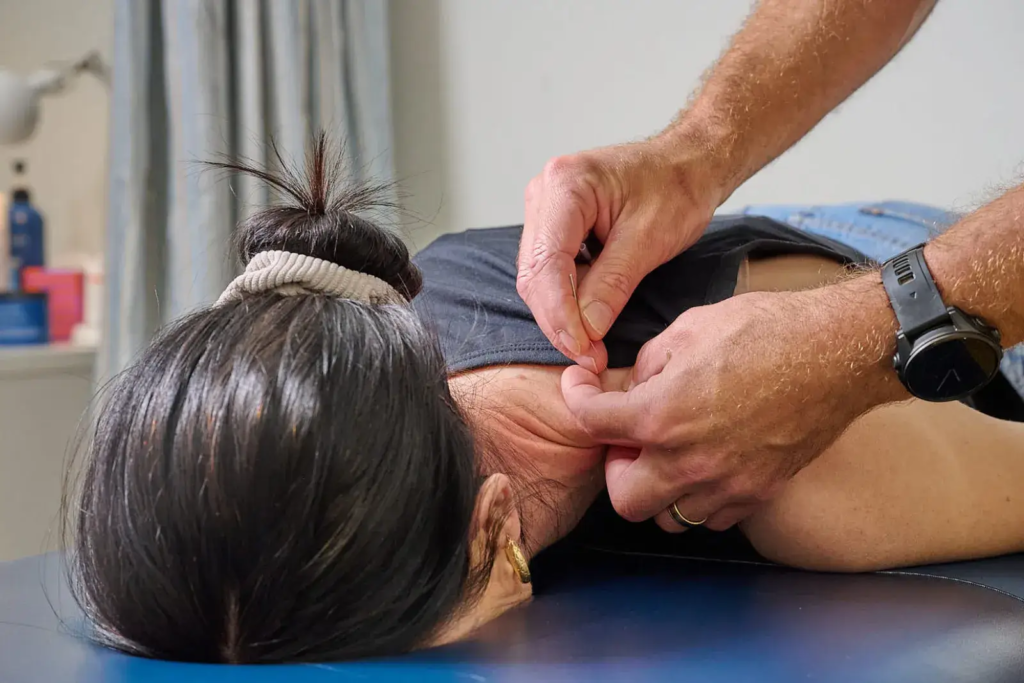
Hands-on techniques including soft tissue release of the forearm extensor muscles, joint mobilisation of the elbow and wrist, and dry needling can provide meaningful pain relief and improve tissue quality as an adjunct to exercise. We use these in combination with exercise, not instead of it.
Load management and education
Understanding what aggravates the tendon and modifying activity accordingly is a key part of the recovery process. This does not mean stopping everything. It means being smart about what you do and how much, so the tendon can recover in between sessions.
Bracing and strapping
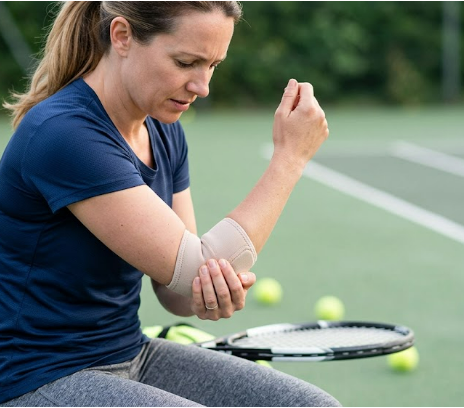
A counterforce brace (also called a tennis elbow brace) worn just below the elbow can help reduce the load through the tendon during activity and provide pain relief. It is not a long-term solution, but it can be useful in the early stages or when returning to work or sport.
What does not work
| Important: Corticosteroid injections are not recommendedCorticosteroid (cortisone) injections were previously a common treatment for both tennis elbow and golfer’s elbow. The evidence no longer supports their use. While injections can provide short-term pain relief, research consistently shows they are associated with worse long-term outcomes, including higher recurrence rates and potential damage to tendon tissue. The Australian evidence-based guidelines do not recommend them as a routine treatment. |
Golfer’s Elbow Treatment
The treatment principles for golfer’s elbow are very similar to tennis elbow, with the key difference being that the exercises target the flexor-pronator muscle group rather than the extensor group.
Treatment typically includes:
- Progressive loading exercises for the wrist flexors and forearm pronators, following the same isometric to isotonic progression used for tennis elbow.
- Soft tissue work to the flexor-pronator muscle belly, which is often very tight and tender alongside the tendon.
- Ulnar nerve mobilisation if nerve involvement has been identified during assessment.
- Activity modification and load management, particularly if the aggravating activity involves heavy gripping or repetitive wrist flexion.
- Technique review for those whose condition is linked to sport or specific tasks, such as golf swing mechanics or grip size.
One specific note for golfer’s elbow: if nerve symptoms are present (tingling or numbness into the ring or little finger), treatment needs to address both the tendon and the nerve component. Treating only the tendon will leave the nerve symptoms unresolved.
Tennis Elbow Exercises: What Should You Actually Be Doing?
The right exercises depend on where you are in your recovery. Starting with exercises that are too aggressive too early can flare things up. Starting with exercises that are too gentle and not progressing them means the tendon never adapts properly.
Here is a general framework for what a progressive tennis elbow exercise program looks like:
Phase 1: Isometric loading (weeks 1 to 2)
Isometric exercises involve holding a contraction without movement. They are effective for pain reduction in the early stages and are a low-risk way to begin loading the tendon.
- Wrist extension isometric hold: place your forearm on a table, wrist over the edge. Use your other hand to resist your attempt to bend the wrist back. Hold for 30 to 45 seconds, 5 repetitions.
- Grip hold: squeeze a soft ball or rolled towel for 30 to 45 seconds without movement.
Phase 2: Isotonic loading (weeks 2 to 6)
Isotonic exercises involve movement through a range of motion under load. This is where most of the tendon adaptation happens.
- Eccentric wrist extension: forearm on a table, wrist over the edge. Use your goodunaffected hand to lift the bad handweight, remove the good hand’s support, then lower slowly usingwith the affected side only. 3 sets of 15 repetitions.
- WeightedHeavy slow resistance wrist extension: perform both the lifting and lowering phases slowly onwith the affected side, with a light dumbbell or resistance band. 3 sets of 15 repetitions.
- Forearm supination and pronation with a weighted tool (like a hammer): the rotating load targets the extensor tendonsECRB effectively.
Phase 3: Functional and sport-specific loading (from week 6)
Once the tendon has built capacity through phases 1 and 2, we begin reintroducing higher-load, more dynamic activities relevant to your sport or work.
- Racquet swings with progressive resistance.
- Sport-specific grip and wrist exercises.
- Return to full work duties or sport activity in a graded way.
| Quick note on pain monitoring during exerciseSome discomfort during loading exercises is acceptable and expected. We use a 0 to 10 pain scale and generally advise staying below 4 out of 10 during exercises. If pain is above that level during the exercise, reduce the load. If pain lingers for more than 24 hours after a session, that session was too much and we need to back it off. |
These are general frameworks. An individualised program from your physio will be calibrated to your specific presentation, your capacity, and your goals.
How Long Does Recovery Take?
This is the question everyone wants answered, and I want to be straight with you about it.
Tennis elbow and golfer’s elbow are both conditions that take time. Full recovery typically takes 3 to 6 months, sometimes longer if the condition has been present for a long time before treatment starts.
That said, most people see meaningful improvement much earlier than that. Within the first 4 to 6 weeks of a structured program, pain usually reduces significantly and function starts to return. The 3 to 6 month timeline refers to full resolution and the ability to return to unrestricted activity.
If you’re returning to sport after time off, it’s also worth reading our article on pre-season training for injury prevention. — Tthe load management principles mentioned translate directly to elbow rehab and sport return.
Factors that influence recovery time include:
- How long you have had the condition before starting treatment. Earlier treatment almost always means faster recovery.
- How consistently you do your rehab exercise program.
- Whether the aggravating activity can be modified during recovery.
- Your overall health and tissue healing capacity.
Never a dull moment in clinic, but elbow tendinopathy is one of those conditions where I always feel good telling people the prognosis. With the right approach and a bit of patience, the outcomes are genuinely good.
When Should You See a Physio for Elbow Pain?
Honestly, sooner rather than later. That is not just a standard physio answer. For tendinopathy specifically, the evidence shows that earlier intervention leads to faster recovery and reduces the risk of the condition becoming chronic.
You should book in if:
- You have had elbow pain for more than 2 weeks.
- The pain is affecting your work, sport, or everyday tasks like opening jars, turning taps, or typing.
- You have tried rest and the pain keeps coming back.
- You have tingling or numbness in the hand or fingers alongside the elbow pain.
- You have tried exercises you found online and they are not helping.
The Australian Physiotherapy Association recommends physiotherapy as first-line management for lateral and medial elbow tendinopathy, ahead of injections or other interventions.
You can book online with Physio Club or reach out to the Sutherland clinic. If you’re not sure, give us a call. We’re always happy to have a chat about whether coming in makes sense for your situation.
FAQs
What is tennis elbow?
Tennis elbow (lateral epicondylitis or lateral elbow tendinopathy) is a condition involving degeneration of the tendons that attach the forearm extensor muscles to the outside of the elbow. It causes pain and tenderness at the lateral epicondyle, reduced grip strength, and pain with wrist extension and gripping activities. Despite the name, it commonly affects people who have never played tennis.
What is the difference between tennis elbow and golfer’s elbow?
The key difference is location. Tennis elbow causes pain on the outer (lateral) side of the elbow and involves the extensor tendons. Golfer’s elbow causes pain on the inner (medial) side and involves the flexor tendons. Both are tendinopathy conditions caused by repetitive overload, but they require different exercises targeting different muscle groups.
How do I know if I have tennis elbow?
Common signs include pain or tenderness on the outside of the elbow, reduced grip strength, and pain that worsens when you try to extend your wrist back against resistance. Fine motor tasks like using cutlery, turning a key, or opening a jar often reproduce the pain. A physiotherapy assessment will confirm the diagnosis and rule out other conditions.
Can tennis elbow heal on its own?
Some mild cases do settle with rest and activity reduction. However, many people find the pain returns as soon as they resume the aggravating activity, because the underlying tendon degeneration has not been addressed. A structured progressive loading program is the most evidence-based way to drive real tissue adaptation and prevent recurrence.
What is the fastest way to fix tennis elbow?
There is no instant fix, but starting a physiotherapy-guided program early, being consistent with your exercises, and making smart adjustments to your activity load gives you the best chance of the fastest recovery. Trying to push through pain without addressing the load management usually prolongs recovery rather than shortening it.
Is it okay to keep working with tennis elbow?
In most cases, yes, with modifications. Complete rest is rarely necessary or helpful. Your physio can help you work out what modifications make sense for your specific job or activity, so you can stay productive while giving the tendon the best chance to recover.
Do cortisone injections work for tennis elbow?
Cortisone injections can reduce pain in the short term, but the evidence shows they are associated with worse outcomes at 12 months compared to physiotherapy or a wait-and-see approach. They are no longer recommended as a routine treatment for tennis elbow or golfer’s elbow.
Can a physio treat tennis elbow in Sutherland or Engadine?
Yes. The team at Physio Club regularly treats both tennis elbow and golfer’s elbow. We do a thorough assessment, confirm the diagnosis, and build an individualised treatment plan from there.
Final Thoughts
Tennis elbow and golfer’s elbow are two conditions that frustrate people for the same reason: they hang around. They are not the kind of injury that gets better with a week off. And because the pain often fluctuates, it is easy to get caught in a cycle of feeling okay, going back to full activity, and then flaring up again.
The way out of that cycle is understanding what is happening in the tendon and what it actually needs to recover. Not rest. Not a cortisone injection. Progressive loading, consistently applied, with smart activity management around it.
The outcomes for both conditions under physiotherapy care are genuinely encouraging. Most people get back to full, pain-free activity. It just takes a bit of time and the right approach.
If you have been putting up with elbow pain and hoping it will sort itself out, this is a good time to get it properly assessed. The sooner you start the right treatment, the faster you get back to doing what you love without thinking about your elbow every time you pick something up.
Get in touch with the team at Physio Club and let’s work out a plan. If you’ve got questions, feel free to reach out. We’re always happy to help.
— Tom HolPhysiotherapist and Business Owner, Physio Club