Key Takeaways
- A corked muscle (muscle contusion) is a direct impact injury and not just a bruise. It involves real damage to muscle tissue and blood vessels.
- There are three grades of severity and two types (intramuscular and intermuscular). Both matter for how you treat it and how long recovery takes.
- The first 48 hours are critical. Follow the PRICE protocol and avoid heat, alcohol, and massage in the acute phase.
- Physiotherapy speeds recovery and reduces the risk of serious complications like myositis ossificans (the abnormal formation of bone tissue within muscle tissue)
- Grade 2 and Grade 3 corks should always be assessed by a physiotherapist. Return to sport should be clinically cleared, not just based on how it feels.
- Quick note: every person’s situation is different. Please talk to your physio or doctor about your specific circumstances. This article is here to help you ask the right questions, not replace professional advice.
It’s no secret that a corked muscle can stop you in your tracks.
One moment you’re in the thick of the game, fully committed to the contest. The next, your opponent’s knee has made direct contact with your thigh, and you’re limping off the field wondering how bad it actually is.
We see corked muscles regularly here at Physio Club across both our Sutherland and Engadine clinics. Footy players, basketballers, rugby players, netballers, weekend warriors. They all get them. And they’re one of those injuries that people consistently underestimate.
A lot of people think they can just run it off or that a bit of rest and a hot shower will sort things out. Sometimes that works. But often it doesn’t, and the wrong early management can turn a mild cork into a much longer recovery.
So today I want to give you a proper breakdown. What’s actually happening when you get a cork, how we figure out how serious it is, and what good treatment looks like, so you can get back to doing what you love as quickly and as safely as possible.
What Is a Corked Muscle?
A corked muscle, also called a corky, dead leg, Charley horse, or muscle contusion, is a direct impact injury that causes bruising and bleeding within the muscle tissue.
In sport, this usually means getting kneed hard in the thigh during a tackle or collision. The muscle gets compressed against the bone beneath it, and the force of that impact causes damage to the small blood vessels inside the muscle.
The thigh (quadriceps) is the most common site, but you can also cork your calf, hamstring, or other muscle groups.
According to Sports Medicine Australia, muscle contusions are among the most common contact injuries in Australian sport, particularly in football codes and court sports.
The big thing I want to emphasise here is this: a corked muscle is not just a bruise. It is an injury to the muscle tissue itself, and treating it the wrong way in those first 24 to 48 hours can significantly slow your recovery.
How Bad Is It? The Three Grades of a Corked Muscle
Not all corks are the same. One of the first things we do at Physio Club when we assess a corked muscle is work out the grade. That tells us a lot about the tissue damage involved, what treatment is appropriate, and what a realistic return to sport timeline looks like.
The Better Health Channel classifies muscle contusions into three grades based on function, pain, and range of motion. Here is what each one typically looks and feels like.
Grade 1: Mild Contusion
You will know it happened, but you can probably keep moving. A Grade 1 corked muscle generally presents with:
- Some tightness and tenderness in the muscle
- A slight limp or altered walking pattern
- Minimal swelling
- Minimal loss of range of motion when you lie face down and bend your knee
- Little to no pain when trying to extend the knee against resistance
With solid early management, most Grade 1 corks resolve within a few days to a week. The key is not rushing back to full training too early, which is where a lot of people come unstuck.
Grade 2: Moderate Contusion
Grade 2 is a step up in severity. You will likely experience:
- A noticeable limp and difficulty walking normally
- Sudden pain twinges during activity
- Visible swelling around the thigh
- Tenderness when you press the area
- Pain when extending the knee against resistance
- Difficulty bending the knee fully
Recovery at this grade typically takes one to three weeks with proper physiotherapy. Without good management, that timeline can stretch considerably. We have seen Grade 2 corks drag on for six or more weeks when people tried to manage them on their own.
Grade 3: Severe Contusion
This is the injury that immediately tells you something serious has happened. Grade 3 corked muscles are characterised by:
- Significant difficulty bearing weight, often requiring crutches
- Severe pain at rest and with any movement
- Immediate and obvious swelling
- Significant loss of muscle function and strength
Grade 3 contusions need a proper physio assessment as soon as possible. We will want to rule out associated injuries such as a muscle tear, arrange imaging if necessary, and set you up with a structured rehabilitation plan from day one.
Not sure what grade you are dealing with? That is exactly what we are here for. Book in with our team and we will give you a clear picture of what is going on and what comes next.
Intramuscular vs Intermuscular: Why the Type Matters
Here is something most people do not know about corked muscles, and it is actually really important for understanding your recovery.
There are two distinct types of muscle contusion, and knowing which one you have changes your treatment approach and your expected timeline.
Intramuscular Contusion
With an intramuscular contusion, the bleeding stays contained within the muscle sheath (the connective tissue surrounding the muscle). Because the sheath holds everything in, the pressure builds up and stops the bleeding fairly quickly.
That sounds like a good thing, but not exactly. That contained swelling means significant loss of function, intense pain, and real reduction in power and strength. Because the blood has nowhere to go, resolution takes longer. Recovery can range from days to several weeks depending on severity.
Another thing to watch with intramuscular contusions is a rare but serious complication called myositis ossificans, where, if handled poorly, calcium deposits form in the damaged muscle. More on that below.
Intermuscular Contusion
With an intermuscular contusion, the bleeding seeps between muscle groups rather than staying contained. This means the bleed takes longer to stop initially, especially if you skip the ice and compression in those first 24 hours.
The trade-off is that resolution is generally faster. The blood disperses and is reabsorbed more readily by the body. You are also more likely to see bruising come out on the surface of the skin 24 to 48 hours after the injury.
Our physios can often differentiate between the two types through clinical assessment alone, using range of motion tests, palpation, and strength testing.
In some cases, we will refer for an ultrasound scan to confirm the diagnosis. According to Healthdirect Australia, ultrasound is the most practical imaging tool for assessing soft tissue injuries like contusions in a clinical setting.
What Is the Best Treatment for a Corked Muscle?
I get asked this constantly. And here is the thing: treatment depends on the grade and the type, which is exactly why a proper assessment matters. But let us walk through the principles.
The First 24 to 48 Hours: Get This Right
The first two days after a cork are genuinely critical. What you do, and what you do not do, in this window has a direct impact on how long your recovery takes.
The gold standard is the PRICE protocol (Protection, Rest, Ice, Compression, and Elevation).
- Protection: Offload the injured leg. If you need crutches to walk comfortably, use them.
- Rest: Stop the activity. Come off the field and avoid any exercise that load the muscle.
- Ice: Apply ice wrapped in a cloth, never directly on the skin, for 15 to 20 minutes every one to two hours in the first 24 hours.
- Compression: Wrap the muscle firmly with a compression bandage to limit swelling and provide support.
- Elevation: Rest with the injured muscle elevated above heart level where possible.
And just as important, here is what not to do in the first 48 hours.
- No heat (including hot packs, hot showers, or heat rubs). Heat increases blood flow and makes swelling worse.
- No alcohol. A classic post-game mistake that increases bleeding and delays healing.
- No massage over the injury site. This can increase haematoma formation and, in severe cases, increase the risk of myositis ossificans.
- No anti-inflammatory medications without medical advice (there is ongoing debate about their use in the early stages of muscle injury).
Physio Treatment: The Structured Approach
Once the acute phase has settled, usually after 48 to 72 hours, this is where we really get to work.
Our sports physiotherapy team at Physio Club will build a rehabilitation program that progresses through several clear stages.
Stage 1: Acute Management (Days 1 to 3)
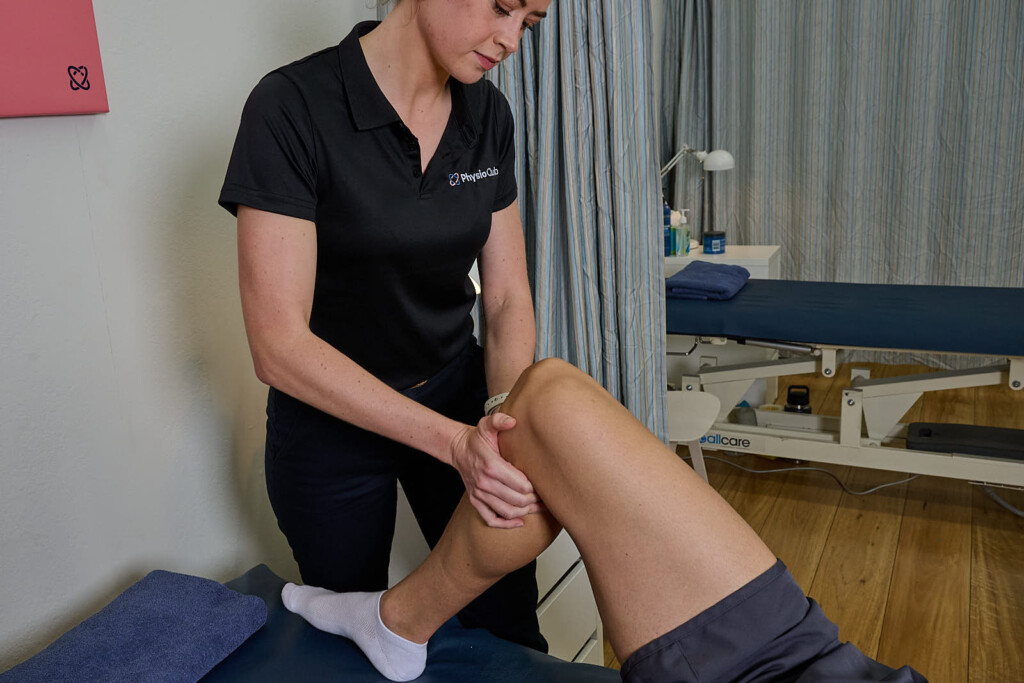
- Hands-on assessment to determine grade and type
- Referral for imaging if needed
- PRICE protocol education and monitoring
- Gentle range of motion work to prevent excessive stiffness
- Pain management guidance
Stage 2: Early Rehabilitation (Days 3 to 10)
- Progressive, pain-free range of motion exercises
- Gentle muscle activation to prevent atrophy
- Manual therapy techniques to support tissue healing
- Heat therapy introduction once the acute phase has resolved
- Pool walking or hydrotherapy, if appropriate
Stage 3: Strength and Function (Weeks 2 to 4)
- Progressive strengthening from bodyweight to loaded exercises
- Gait retraining to restore normal walking and running patterns
- Proprioception and balance work
- Gradual introduction of sport-specific movement patterns
Stage 4: Return to Sport (Weeks 3 to 6 and beyond)
- High-speed running progressions
- Agility and change of direction drills
- Contact work clearance for collision sports
- Objective return to sport testing (not just pain-free, but genuinely ready)
Not just because it helps you feel better faster.
Not just because it gets you back on the field sooner.
But because a well-managed cork reduces the risk of it becoming a recurring problem. Reinjury to the same site is common when people rush back, and each reinjury carries more risk of complications.
Myositis Ossificans: The Complication You Need to Know About
Myositis ossificans is something we talk to patients about when a cork is moderate to severe. It is worth mentioning here, because it is not widely known.
Myositis ossificans is a condition where calcium deposits form inside the damaged muscle. It typically develops two to eight weeks after a significant contusion, and it can turn what should be a straightforward recovery into something much more prolonged.
The risk factors are well documented in sports medicine literature: early return to activity, massage over the injury site in the acute phase, heat applied too early, and repeated trauma to the same area.
The Australian Institute of Health and Welfare notes that sports injuries treated without proper clinical guidance have significantly higher rates of complications and reinjury than those managed with professional support from the start.
This is exactly why getting a proper assessment early matters. Not just to speed up recovery, but to make sure you are not inadvertently making things worse.
If your cork is not improving as expected, or you are three to four weeks out and still struggling with range of motion and strength, come in and let us take a look. There may be more going on that needs to be addressed. Book online here.
When Should You See a Physio for a Corked Muscle?
Honestly? If you are questioning whether you need to come in, just come in.
I know that sounds like the obvious answer from a physio. But the reality is that the people who get the best outcomes are the ones who get assessed early, get a clear picture of what they are dealing with, and follow a proper plan from day one.
Come and see us if:
- You are still walking with a limp 24 hours after the injury
- Swelling is significant or getting worse rather than better
- You have pain at rest, not just with movement
- You think it might be a Grade 2 or Grade 3 injury
- You have corked the same area before and it keeps happening
- You are unsure about what you should and should not be doing in recovery
- You want to make sure you are on track for return to sport
One thing I would also flag: if you play a collision sport and you have had multiple corks to the same area over a season, it is worth a thorough assessment to check for any signs of early complications. This is something our sports physio team at both Sutherland and Engadine see regularly, and it is something we are well set up to help with.
Realistic Recovery Timelines
I always want to give people an honest picture of what to expect. Not the best case, not the worst case, but a realistic one.
Grade 1 Cork
- Return to training: 3 to 7 days
- Return to full contact sport: 7 to 14 days
- Key: Correct early management and not rushing the return
Grade 2 Cork
- Return to training: 1 to 3 weeks
- Return to full contact sport: 3 to 5 weeks
- Key: Structured physio rehabilitation and progressive loading
Grade 3 Cork
- Return to training: 3 to 6 weeks
- Return to full contact sport: 6 to 12 weeks and sometimes longer
- Key: Early imaging, close physio monitoring, and clearance-based return to sport
Everyone’s timeline looks a little different. Factors like age, fitness level, how well you managed the first 48 hours, and how consistently you do your rehab all play a role.
What I can tell you is that the athletes who get the best and fastest outcomes are the ones who take it seriously from the start. Not the ones who try to push through, and not the ones who rest completely and do nothing. The sweet spot is active, guided recovery.
We Are Proud to Support Local Sport
How good is it being part of a community where people genuinely love their sport? We are lucky to work with athletes from across the Sutherland Shire; from junior club footy to local league competitions to the weekend park runners who are just as committed to their Saturday morning ritual as any elite athlete.
We see a lot of corked muscles throughout the winter sports season in particular. And every single time we help someone get back on the field, back to their team, back to the thing that keeps them going, that never gets old for us.
At Physio Club, we genuinely care about your recovery. Not just your injury, but you. Your goals, your season, your history, your lifestyle. That is what community physio should feel like.
Ready to get sorted? If you have picked up a corky and you are not sure what to do next, book online here or give our friendly team a call at Physio Club Sutherland or Physio Club Engadine. We will get you assessed, give you a clear plan, and get you moving in the right direction.
References and Further Reading
The following credible sources were referenced in this article.
- Sports Medicine Australia: PRICE Management of Acute Soft Tissue Injuries
- Better Health Channel (Victoria State Government): Muscle Bruising and Contusion
- Healthdirect Australia: Muscle Contusion
- Australian Institute of Health and Welfare: Sports Injury in Australia
This article is intended as general information only and does not replace professional medical advice. If you are unsure about your injury, please speak with a qualified physiotherapist or healthcare provider.